
AI and Automation in Medical Coding: Will Coders Be Replaced?
The Big Question on Every Coder's Mind
Artificial intelligence (AI) and automation are transforming industries worldwide, and medical coding is no exception. From computer-assisted coding (CAC) systems to natural language processing (NLP) tools that read physician notes, technology is advancing rapidly. This leads to an anxious question for students, freshers, and experienced coders alike: Will AI replace medical coders?
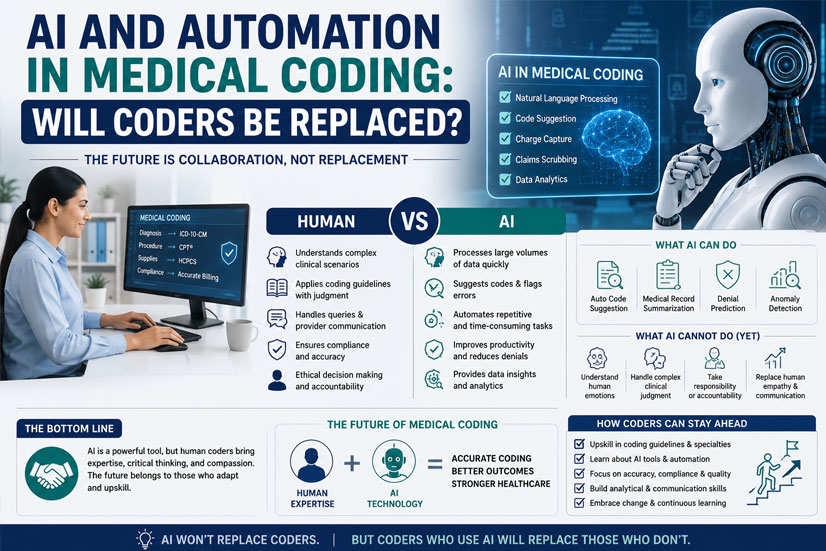
The short answer is: No, AI will not replace medical coders entirely — but it will change the profession dramatically. Coders who adapt, upskill, and embrace technology will thrive. Those who resist change may struggle. Let's explore what AI actually does today, what it cannot do, and how you can future-proof your medical coding career.
What AI in Medical Coding Looks Like Today
AI in medical coding is primarily seen through Computer-Assisted Coding (CAC) systems. These tools use NLP and machine learning algorithms to analyze clinical documentation (physician notes, operative reports, discharge summaries) and suggest appropriate ICD-10-CM, CPT, and HCPCS codes. Major EHR vendors (Epic, Cerner) and specialized CAC companies (3M, Optum, Nuance) offer these solutions.
How does it work? The AI scans text, identifies key terms (diagnoses, procedures, anatomical locations), and applies logic to propose codes. For example, if a note says "patient with type 2 diabetes mellitus," the AI might suggest E11.9. For a "laparoscopic cholecystectomy," it might propose CPT 47562. Some systems also check for compliance with NCCI edits and medical necessity.
However, today's AI is not perfect. Accuracy varies by documentation quality, specialty, and complexity. Most systems achieve 60-80% accuracy for straightforward cases, but drop significantly for complex, multi-diagnosis, or poorly documented encounters. That's where human coders remain essential.
What AI Cannot Do (Yet)
Despite impressive advances, AI has critical limitations. First, AI cannot truly understand clinical context the way a human coder can. It cannot resolve contradictions in a medical record, infer undocumented but clinically implied conditions, or apply nuanced coding guidelines that require judgment. For example, determining the principal diagnosis in a complex inpatient stay with multiple active conditions still requires human expertise.
Second, AI cannot handle ambiguity or incomplete documentation effectively. When a physician writes "chest pain likely cardiac," a human coder knows to query the provider for clarification. AI might incorrectly assign a cardiac code without confirmation, leading to compliance risks. Third, AI lacks critical thinking and ethical judgment — it cannot decide when a documentation query is necessary, nor can it interpret payer-specific policies that vary widely.
Fourth, AI struggles with rare diseases, new procedures, and evolving guidelines. Machine learning models are trained on historical data. When COVID-19 emerged, AI systems had no codes for it until human experts created new codes and retrained models. Human coders lead the way; AI follows.
Will AI Reduce Demand for Entry-Level Coders?
This is a valid concern. As CAC systems improve, some routine, low-complexity coding tasks (e.g., straightforward office visits, uncomplicated E/M coding) may become partially automated. Hospitals and clinics may need fewer entry-level coders for basic charge capture. However, this doesn't mean job loss — it means job transformation.
The same technology that automates simple cases creates new roles: CAC system trainers, AI auditors, coding quality analysts, denial specialists who investigate AI errors, and clinical documentation improvement (CDI) specialists. These roles require coding expertise plus technical fluency. Entry-level coders who learn to work alongside AI — reviewing, correcting, and optimizing its suggestions — become more valuable, not less.
The Auditor Role: Humans Overseeing AI
In hospitals using CAC, the typical workflow is: AI pre-codes the record → a human coder reviews, edits, and validates → final codes are submitted. The coder's role shifts from "code every line" to "audit and correct AI output." This requires even stronger clinical knowledge, because you must catch subtle AI errors. Coders who understand anatomy, pathophysiology, and guidelines thoroughly will excel. Those who only memorized code books may struggle.
Many organizations report that CAC increases coder productivity by 20-40%, allowing them to handle higher volumes or focus on complex cases. This can reduce burnout and increase job satisfaction. But it also means coders must be comfortable with technology, data analytics, and continuous learning.
Skills to Future-Proof Your Medical Coding Career
So how do you ensure AI becomes your tool, not your replacement? Here are actionable strategies:
- Deepen clinical knowledge: Don't just memorize codes — understand disease processes, treatment pathways, and surgical techniques. AI is weaker on complex, rare, or atypical cases.
- Master auditing and compliance: Learn how to identify coding errors, perform internal audits, and educate providers. AI cannot replace human auditing judgment.
- Learn CDI (Clinical Documentation Improvement): CDI specialists work with physicians to improve documentation specificity. This is a high-value, AI-resistant role.
- Get certified in CAC tools: Familiarity with 3M, Optum, Epic CAC, or similar systems is a marketable skill. Many vendors offer training.
- Develop data analytics skills: Basic Excel, SQL, or coding data analysis helps you track denial patterns, AI accuracy rates, and productivity metrics.
Will AI Ever Fully Replace Coders? A Realistic View
For AI to fully replace human coders, several breakthroughs would be needed: general artificial intelligence that truly understands clinical context, ability to query physicians autonomously, integration with real-time payer policy changes, and legal/regulatory acceptance of AI-only coding. That is at least 10-20 years away, if it happens at all. Even then, human oversight will likely remain mandatory for compliance, audits, and appeals.
Consider this analogy: ATMs did not eliminate bank tellers — they changed their role. Tellers shifted from cash dispensing to solving complex customer problems, selling services, and handling exceptions. Similarly, AI will handle routine coding, while human coders focus on complex cases, denials management, CDI, auditing, and compliance. The Bureau of Labor Statistics projects medical coding and health information jobs to grow 8% from 2022 to 2032 (faster than average), with about 15,000 openings annually.
What Employers Look for in the AI Era
In interviews, expect questions like: "How would you handle a CAC system that suggests the wrong code for a complex case?" Or "Describe your experience with technology in coding." Employers want coders who see AI as a teammate, not a threat. Highlight your attention to detail, problem-solving, and willingness to learn new software. Mention any experience with EHRs, CAC, or coding audit tools.
Also, be prepared to discuss ethical AI use in healthcare. Employers value coders who understand that AI outputs must be validated, that patient safety and compliance come first, and that human judgment remains irreplaceable.
Conclusion: The Future Is Collaboration, Not Replacement
AI and automation are reshaping medical coding, but they are not eliminating the profession. Instead, they are raising the bar. Routine coding will become more automated, but complex coding, auditing, CDI, denial management, and compliance will grow in importance. Medical coders who embrace lifelong learning, deepen clinical knowledge, and become proficient with AI tools will find abundant opportunities.
If you're a student or fresher: don't be afraid of AI — be curious. Learn coding fundamentals thoroughly, then learn how CAC works. The best coders of the future will be hybrid experts: part coder, part auditor, part data analyst. That's an exciting, resilient career path.
Ready to future-proof your career? Start by taking a free online course on computer-assisted coding (many are available on AAPC or AHIMA platforms). Then, practice reviewing AI-suggested codes (if available in your training) and identify at least three reasons why a human coder would override the AI. That exercise will prepare you for the real world of modern medical coding.
