
How to Read and Interpret Medical Records for Accurate Coding
The Coder's Most Critical Skill
Medical coding is not about memorizing code books — it's about interpreting clinical documentation. A medical record tells a patient's story: symptoms, diagnoses, treatments, and outcomes. Your job as a coder is to translate that story into accurate ICD-10-CM, CPT, and HCPCS codes. One missed detail can lead to denials, audits, or revenue loss. This guide will teach you how to read medical records systematically and extract the right codes with confidence.
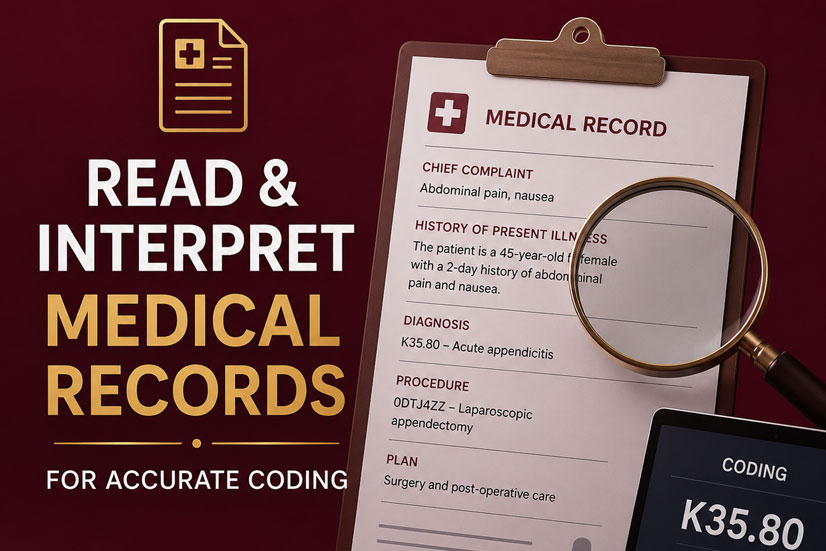
Whether you're a fresher preparing for interviews or an experienced coder looking to improve accuracy, mastering medical record interpretation is your most valuable skill. Let's break down each component of a typical medical record and explore strategies for efficient, accurate coding.
1. Understanding the Structure of a Medical Record
A complete medical record contains several sections. For inpatient coding, you'll typically see:
- History & Physical (H&P): Admission history, chief complaint, past medical history, review of systems.
- Progress Notes: Daily updates on patient status, new findings, treatment changes.
- Operative Report: Detailed description of any surgery performed.
- Consultation Reports: Specialist evaluations.
- Discharge Summary: Final diagnosis, procedures performed, disposition.
- Laboratory & Radiology Reports: Supporting evidence for diagnoses.
For outpatient coding (clinic notes, ED records), the structure is shorter but includes similar elements: chief complaint, history of present illness (HPI), exam findings, assessment/plan, and procedure notes.
2. Where to Find the Principal Diagnosis (Inpatient)
For inpatient records, the Discharge Summary is your most important document. The attending physician's final diagnosis statement usually appears near the end. Look for phrases like "Final Diagnoses:" or "Principal Diagnosis:" However, don't stop there — cross-reference with the H&P and progress notes to ensure the principal diagnosis truly meets UHDDS definition (the condition chiefly responsible for admission). Sometimes the discharge summary lists multiple diagnoses but doesn't specify which is principal. In such cases, you must analyze the entire record.
Pro tip: Never code solely from the discharge summary's diagnosis list. Always verify that each listed diagnosis is documented elsewhere in the record with clinical evidence (labs, imaging, physician notes). This prevents "copy-forward" errors where outdated diagnoses persist incorrectly.
3. Extracting Procedures from Operative Reports
Operative reports are gold mines for CPT (outpatient) or ICD-10-PCS (inpatient) codes. Read systematically:
- Preoperative & Postoperative Diagnoses: These often differ — code the final diagnosis confirmed during surgery.
- Procedure Performed: Look for the exact procedure name (e.g., "laparoscopic cholecystectomy" not just "gallbladder surgery").
- Surgical Approach: Open, laparoscopic, robotic, percutaneous — critical for ICD-10-PCS.
- Body Part & Laterality: Left vs right, specific organ or vessel.
- Device/Implant: Stent, mesh, pacemaker, etc.
- Complications or Unexpected Findings: May require additional codes.
For ICD-10-PCS, the operative report must specify the root operation (excision, resection, bypass, etc.), approach, device, and qualifier. If any element is missing, you may need to query the surgeon.
4. Deciphering Physician Handwriting & Abbreviations
Despite EHR adoption, you'll still encounter illegible handwriting or ambiguous abbreviations. Common problematic abbreviations: "MS" could mean multiple sclerosis, morphine sulfate, or mitral stenosis. Always use context. If unsure, refer to your facility's approved abbreviation list. For unclear handwriting, look at other sections of the record for clues. When documentation is truly insufficient, a formal physician query is necessary — never guess.
5. Identifying Secondary Diagnoses (Inpatient)
For inpatient coding, secondary (comorbid) diagnoses must meet UHDDS criteria: they require clinical evaluation, therapeutic treatment, diagnostic testing, or extended length of stay. Simply listing a condition in the past medical history does NOT justify coding it as a secondary diagnosis unless it was actively treated or monitored during the admission.
Example: A patient admitted for pneumonia who also has controlled hypertension (no med adjustments, no extra monitoring) — the hypertension is not coded as a secondary diagnosis. However, if blood pressure was unstable and medications were adjusted, then code it. This distinction is frequently tested in interviews and exams.
6. Outpatient Records: Focus on the Reason for Encounter
Outpatient coding (clinic, ED, same-day surgery) is encounter-based. The Assessment/Plan section usually lists the diagnoses addressed during that visit. Only code conditions that are documented as:
- Diagnosed or confirmed during the visit, OR
- Chronic conditions that are being managed or assessed (e.g., diabetes with medication adjustment), OR
- Relevant history that affects treatment (e.g., history of mastectomy for a patient with arm swelling).
Do not code every chronic condition listed in the past medical history unless the physician explicitly addresses it in the assessment/plan. For ED records, focus on the final ED diagnosis — not every differential considered.
7. Using Laboratory & Radiology Reports to Confirm Diagnoses
Lab and imaging reports serve as clinical evidence. A diagnosis of "acute pyelonephritis" should be supported by urinalysis results. "Pneumonia" should have chest X-ray confirmation. However, the physician's documented diagnosis takes precedence — you don't assign codes based solely on abnormal labs if the physician didn't diagnose that condition. Use ancillary reports to clarify ambiguous documentation or to confirm laterality (e.g., "left lower lobe pneumonia" from radiology report).
8. Recognizing Documentation Gaps & When to Query
Even experienced coders encounter incomplete records. Common gaps include:
- Missing laterality (left vs right) for a condition or procedure.
- Unspecified diagnosis when a specific code requires more detail (e.g., "diabetes" without type 1 or 2).
- Contradictions (e.g., note says "no acute findings" but assessment lists a new diagnosis).
- Missing principal diagnosis designation on inpatient discharge summary.
When documentation is insufficient, submit a physician query. A good query is compliant — never leading, always clarifying. Example: "The operative report describes 'removal of the gallbladder.' Please clarify: was this an open or laparoscopic approach?" Queries protect your compliance and ensure accurate coding.
9. Efficient Medical Record Reading Strategy (Speed + Accuracy)
Time is money in coding. Develop a systematic approach:
- Scan first: Quickly review all documents to understand the patient story.
- Identify the principal diagnosis (inpatient) or reason for encounter (outpatient).
- Extract all procedures (operative report or procedure note).
- Identify secondary diagnoses (inpatient) or additional conditions addressed (outpatient).
- Cross-check lab/radiology for supporting evidence.
- Apply coding guidelines and assign codes.
With practice, this workflow becomes second nature. Use a coding worksheet or electronic checklist to ensure you don't miss key data elements.
10. Common Mistakes to Avoid
Even skilled coders fall into these traps:
- Coding from the discharge summary alone: Always validate against progress notes and operative reports.
- Assigning codes for "rule out" or "suspected" diagnoses: In outpatient coding, code the condition after evaluation; for inpatient, code the condition to the highest certainty documented.
- Ignoring laterality: ICD-10 is specific — right, left, bilateral, or unspecified. Use radiology reports to confirm.
- Missing the "with" vs "due to" relationships: Coding guidelines specify combination codes (e.g., K86.1 for pancreatitis due to alcohol use).
- Overlooking POA (Present on Admission): Required for inpatient Medicare claims — mark each diagnosis as Y, N, W, or U.
Practical Example: Reading a Discharge Summary
Let's walk through a real scenario. Discharge summary says:
"Patient admitted with chest pain. Troponin elevated, EKG showed ST-segment depression. Underwent cardiac catheterization on 2/10, which revealed 80% stenosis of LAD. Drug-eluting stent placed. Final diagnoses: Non-ST elevation myocardial infarction (NSTEMI), hypertension, hyperlipidemia."
Your coding approach: Principal diagnosis = NSTEMI (I21.4). Secondary diagnoses = hypertension (I10) and hyperlipidemia (E78.5) — only if actively treated during admission (likely yes). Procedure = ICD-10-PCS: catheterization with stent placement into LAD (specific 7-character code). This example shows how you pull from multiple record sections.
Preparing for Interviews: Medical Record Interpretation Questions
Coding interviews often present a short medical record excerpt and ask you to assign codes. Practice this skill. You'll be evaluated on:
- Accuracy of code selection (ICD-10-CM and CPT).
- Identification of principal diagnosis vs. secondary diagnoses.
- Proper use of modifiers (outpatient).
- Recognition of documentation gaps (and whether you would query).
For freshers, emphasize your methodical approach: "I always start by identifying the reason for admission or encounter, then review all documentation before assigning codes. If I find conflicting or incomplete documentation, I would follow facility policy to submit a compliant query."
Conclusion: Master the Medical Record, Master Coding
Reading and interpreting medical records is the heart of medical coding. No technology — not even AI — can fully replace the human coder's ability to understand clinical nuance, resolve contradictions, and apply judgment. By mastering the structure of medical records, knowing where to find key information, and developing a systematic review process, you'll code with confidence, accuracy, and speed.
Start practicing today. Obtain sample medical records (many coding textbooks include them) and time yourself. Identify the principal diagnosis, secondary diagnoses, and procedures. Compare your codes to answer keys. With deliberate practice, you'll transform from a beginner who reads records slowly to an expert who extracts codes efficiently — and that's the skill that employers value most.
Ready to test your skills? Take a free operative report sample online, identify all procedures and diagnoses, then code them using your ICD-10-CM and CPT manuals. If you can defend each code based on documentation, you're on your way to becoming a top-tier medical coder.
