
Day in the Life of a Medical Coder: Roles, Responsibilities, and Workflow
What Does a Medical Coder Actually Do Every Day?
If you're considering a career in medical coding, you've probably wondered: What does a typical workday look like? Is it repetitive data entry? Nonstop phone calls? Solitary screen time? The truth lies somewhere in between. Medical coding is a detail-oriented, analytical profession that blends clinical knowledge with rules-based logic. A typical day varies by setting (hospital inpatient, physician office, remote coding vendor) but shares common workflows, productivity targets, and collaboration touchpoints.
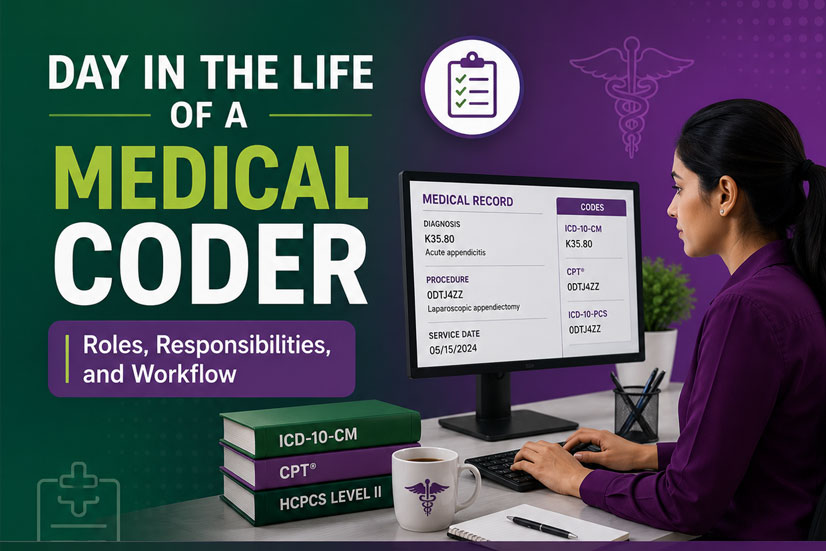
This guide walks you through a realistic day — from morning login to end-of-day tasks — and covers the core responsibilities, productivity expectations, tools, and career paths you'll encounter. Whether you're a fresher or contemplating a specialty, you'll gain clarity on what the job truly entails.
The Big Picture: Coder Roles by Setting
Before diving into the hourly workflow, understand that medical coding roles differ by employer:
- Inpatient Hospital Coder: Codes complex, multi-day stays using ICD-10-CM and ICD-10-PCS. Works with discharge summaries, operative reports, and progress notes. Often specializes by body system.
- Outpatient Facility Coder: Codes emergency department, ambulatory surgery, observation, and clinic visits. Uses ICD-10-CM and CPT/HCPCS. Higher volume, shorter records.
- Physician Practice Coder: Codes professional services (E/M, procedures) for a clinic or multi-specialty group. May handle billing follow-up and denials.
- Risk Adjustment (HCC) Coder: Reviews records retrospectively to capture chronic conditions for Medicare Advantage plans. Often 100% remote.
- Coding Auditor/Educator: Reviews other coders' work, provides feedback, and trains staff. Requires advanced certification (CPMA).
This article focuses primarily on inpatient and outpatient facility coding — the most common entry points for hospital-based coders.
Morning: Log In, Prioritize, and Tackle High-Acuity Charts
Most medical coders start their day between 7:00 AM and 8:30 AM. Remote coders log into a VPN and the coding system (e.g., Epic, Cerner, 3M 360 Encompass). Onsite coders arrive at their cubicle or shared workspace. The first 15-30 minutes involve:
- Checking email for policy updates, payer bulletins, or queries from physicians.
- Reviewing the coding queue — a worklist of charts sorted by discharge date or encounter date.
- Prioritizing: Discharged Not Final Billed (DNFB) charts take precedence, especially those nearing billing deadlines.
- Attending a quick huddle (inpatient teams often do a 10-minute standup to discuss complex cases or documentation issues).
Many coders start with the most complex or time-sensitive charts first (e.g., long ICU stays, major surgeries) when mental energy is highest. Easier, routine charts (e.g., normal newborn, uncomplicated observation) are left for afternoon.
Core Workflow: Reviewing and Coding a Single Chart
How long does it take to code one chart? Anywhere from 5 minutes (simple outpatient clinic note) to 60+ minutes (complex inpatient stay with multiple procedures). Here's the step-by-step process for a typical inpatient record:
- Open the chart in your encoder or EHR. Review patient demographics (age, gender, length of stay).
- Read the Discharge Summary first — identify the principal diagnosis and all listed secondary diagnoses.
- Review the Operative Report(s) — extract procedures, approaches, devices, and laterality.
- Scan Progress Notes to verify that secondary diagnoses meet UHDDS criteria (actively treated, monitored, or extended stay).
- Check Lab and Radiology reports to confirm documented diagnoses.
- Assign ICD-10-CM diagnoses codes using coding guidelines (combination codes, excludes notes, etc.).
- Assign ICD-10-PCS procedure codes (inpatient) or CPT/HCPCS (outpatient).
- Assign POA (Present on Admission) indicators for each diagnosis (Y, N, W, U).
- Enter codes into the encoder/abstracting system, then validate for MS-DRG (inpatient) or APC (outpatient).
- Identify any documentation gaps — if something is missing or ambiguous, create a compliant physician query.
- Finalize the record or save it for query resolution.
Outpatient coders follow a similar but faster process: review the clinic note or ED record, confirm the reason for encounter, assign ICD-10-CM diagnoses, assign CPT/HCPCS codes (including E/M leveling), apply modifiers if needed, and finalize.
Productivity Standards: How Many Charts Per Day?
Employers set productivity expectations based on chart type and complexity. Examples:
- Inpatient (major teaching hospital): 10-20 records per day (complex cases, DRG coding).
- Outpatient facility (ED): 40-60 ED records per day.
- Outpatient clinic (primary care): 60-100 office visit notes per day.
- Ambulatory surgery (ASC): 25-35 operative reports per day.
- Risk Adjustment (HCC): 30-50 records per day (retrospective review).
Quality matters equally. Most organizations require 95%+ accuracy for inpatient coding and 97%+ for outpatient. Coders who consistently meet both productivity and accuracy targets earn bonuses and advancement opportunities.
Mid-Day: Collaboration, Queries, and Education
Coding is not an isolated job. Mid-morning or afternoon, you'll engage in:
- Physician queries: You may contact a physician (via secure messaging or EHR query tool) to clarify incomplete documentation. Example: "The operative report does not specify the approach for the cholecystectomy. Was this open or laparoscopic?"
- Team discussions: Coding managers or lead coders host case reviews for controversial or complex records (e.g., query for principal diagnosis when two conditions seem equally responsible).
- Continuing education (CEUs): Many coders listen to webinars, read AHA Coding Clinic, or complete AAPC/AHIMA modules during slower periods or dedicated training time. Most certifications require 20-36 CEUs every two years.
- Payer updates: New LCDs (Local Coverage Determinations), NCCI edits, or billing rule changes require reading and implementation.
Tools of the Trade: Encoders, EHRs, and Reference Systems
Coders rely on specialized software:
- EHR (Electronic Health Record): Epic, Cerner, Meditech, NextGen — where clinical documentation lives.
- Coding Encoder: 3M 360 Encompass, Optum EncoderPro, TruCode — helps navigate code books, check NCCI edits, and validate DRGs.
- Computer-Assisted Coding (CAC): Natural language processing tools that pre-suggest codes (e.g., 3M CAC, Nuance). Coders review and correct AI suggestions.
- Abstracting system: Collects coded data for billing, quality reporting, and clinical registries.
- Reference materials: ICD-10-CM/PCS code books, CPT professional edition, Coding Clinic, and payer-specific policies (often bookmarked digitally).
Remote coders also use dual monitors (essential for productivity), secure VPN, and often a VoIP phone for team calls.
Afternoon: Chart Completion, Denials, and Administrative Tasks
The afternoon workflow often shifts to:
- Clearing the DNFB queue: Unbilled charts that are approaching timely filing limits (often 30-90 days post-discharge).
- Working denials: Reviewing claims that were rejected or denied due to coding issues (e.g., mismatched diagnosis-procedure pairs, missing modifiers). Correct and resubmit.
- Second-level audits: Senior coders or auditors may review your charts, and you'll receive feedback. For example, "In record #45678, you missed the secondary diagnosis of acute kidney injury — please review the creatinine trends."
- End-of-day reporting: Many coders log their productivity (number of charts coded, query rate) into a spreadsheet or dashboard.
Before logging off, most coders tidy their worklist, leave notes for queries pending physician response, and review the next day's priority charts.
Remote vs. Onsite Coding: Differences in Daily Life
Remote medical coding has grown dramatically. Key differences:
- Commute: Zero (saves 1-2 hours daily).
- Schedule flexibility: Many remote coders work 7 AM - 3:30 PM or 8 AM - 5 PM but with less rigid break monitoring.
- Communication: Slack, Teams, or Zoom instead of in-person huddles. Some coders report feeling isolated; others thrive on autonomy.
- Equipment: Employer typically provides dual monitors, laptop, keyboard, and VPN token. You provide a private, secure workspace with locking door (HIPAA requirement).
- Home office distractions: Requires discipline — pets, family, and errands can interrupt workflow.
Onsite coders have immediate access to colleagues and managers, which can accelerate learning for beginners. Many new coders start onsite, then transition to remote after 1-2 years.
Challenges You'll Face (And How to Handle Them)
No day is perfect. Common challenges:
- Incomplete or illegible documentation: You'll spend extra time deciphering, searching for missing details, or writing queries. Solution: develop a low-tolerance threshold for querying early.
- Productivity pressure: New coders often feel rushed. Solution: Focus on accuracy first; speed improves with experience. Communicate with your manager if you're consistently behind.
- Repetitive strain: Sitting 7+ hours staring at screens. Solution: ergonomic chair, standing desk, frequent micro-breaks, eye exercises.
- Keeping up with guideline changes: ICD-10 updates every October; CPT updates every January. Solution: subscribe to coding newsletters and attend annual training.
Sample Daily Schedule (Inpatient Facility Coder)
7:00 AM – Log in, check emails, review DNFB queue.
7:30 AM – Team huddle (Zoom or in-person). Discuss complex trauma case.
8:00 AM – 10:30 AM – Code high-complexity charts (ICU, cardiac surgery). Focused, uninterrupted.
10:30 AM – 10:45 AM – Break (stretch, hydrate).
10:45 AM – 12:00 PM – Code medium-complexity charts (general medicine). Submit two physician queries.
12:00 PM – 12:45 PM – Lunch (CEU webinar on new ICD-10-PCS root operations).
12:45 PM – 2:30 PM – Continue coding, focusing on DNFB charts. Cross-reference lab results.
2:30 PM – 3:00 PM – Respond to queries from auditors, review feedback from yesterday's audit.
3:00 PM – 3:30 PM – Update productivity log, clear worklist, plan for tomorrow.
3:30 PM – Log off.
Career Progression: From Entry-Level Coder to Director
A typical medical coding career path:
- Years 0-2: Entry-level coder (outpatient or inpatient trainee). Focus on accuracy, learn specialty areas, earn CPC or CCS.
- Years 2-5: Experienced coder. Meet productivity targets consistently. May specialize (cardiology, ED, HCC). Earn specialty credentials (CRC, CIRCC).
- Years 5-8: Senior coder or coding auditor. Train new coders, perform internal audits, lead CDI initiatives. CPMA credential valuable.
- Years 8+: Coding manager, director of HIM, or compliance officer. Responsible for teams, policies, and payer negotiations. RHIA or master's degree helpful.
Many coders also transition into clinical documentation improvement (CDI), revenue cycle management, or coding education.
Interview Prep: Describing Your Typical Day
In coding interviews, you may be asked: "Walk me through a typical day." Emphasize:
- Your methodical approach to reviewing medical records.
- How you prioritize DNFB charts and meet productivity standards.
- Your experience with physician queries (compliant, neutral queries).
- How you stay current with coding guideline updates.
- Your ability to work both independently and collaboratively (huddles, audits).
For freshers, describe your training experience and enthusiasm for learning the workflow. Emphasize attention to detail, time management, and willingness to be coached.
Conclusion: A Rewarding, Structured, and Growing Profession
A day in the life of a medical coder is structured yet intellectually engaging. You'll solve clinical puzzles, ensure accurate reimbursement, and protect patients and providers from compliance risks. The work demands focus, but it offers stability, remote flexibility, and clear advancement paths. For detail-oriented individuals with a passion for healthcare and rules, medical coding delivers a meaningful career.
If this day sounds appealing, take the next step: shadow a coder (many organizations allow virtual shadowing), take an introductory medical coding course, or start studying for the CPC certification. The healthcare industry needs thousands of new coders — and one of those roles could be your daily reality.
Ready to experience the workflow yourself? Download a free sample medical record from an online resource, time yourself as you code it, and compare your codes to an answer key. Track how long it takes. That's your first step toward understanding a real coder's day.
