
Top Medical Coding Certifications in 2026 and Their Career Benefits
Why Certification Matters More Than Ever
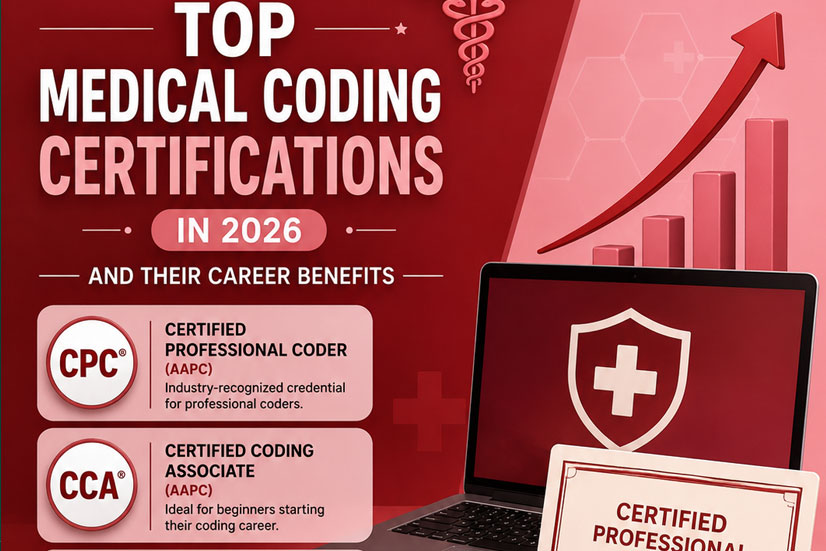
In medical coding, certification is not just a line on your resume — it's the gold standard that separates professionals from hobbyists. Employers increasingly require or strongly prefer credentialed coders. As AI and automation reshape the field, certified coders who demonstrate validated expertise command higher salaries, better job security, and faster advancement. But with multiple credentials from AAPC and AHIMA, how do you choose? This guide compares the top certifications for 2026, their exam requirements, career benefits, and salary impact.
Whether you're a student, a career changer, or an experienced coder looking to specialize, understanding each credential's focus and recognition will help you map your path. Let's examine the most valuable certifications for 2026.
The Two Major Credentialing Bodies: AAPC vs AHIMA
AAPC (American Academy of Professional Coders) – Founded in 1988, AAPC focuses primarily on outpatient, physician office, and professional fee coding. Their certifications emphasize CPT, HCPCS, and ICD-10-CM for outpatient settings. AAPC boasts over 200,000 members worldwide.
AHIMA (American Health Information Management Association) – Founded in 1928, AHIMA takes a broader health information management approach. Their coding certifications (CCS, CCA) focus heavily on inpatient hospital coding, ICD-10-PCS, and facility-level abstracting. AHIMA credentials are often preferred for hospital inpatient roles.
Many successful coders earn credentials from both organizations over their careers. For beginners, the choice often depends on your target setting: outpatient/physician practice → AAPC's CPC; inpatient hospital → AHIMA's CCS.
1. CPC (Certified Professional Coder) – AAPC
The CPC is the most recognized and requested medical coding certification in the United States, especially for outpatient and physician office settings. It validates proficiency in ICD-10-CM, CPT, and HCPCS Level II coding, including Evaluation & Management (E/M), surgery, radiology, pathology, and medicine sections.
Exam details (2026): 100 multiple-choice questions, 4 hours, open code books (manuals with highlights allowed). Requires 2 years of coding experience (or apprenticeship designation until experience is met). Cost: $399 (AAPC member) + study materials.
Career benefits: Highest demand credential for physician practices, outpatient clinics, ambulatory surgery centers, and remote coding vendor jobs. CPCs earn average salaries of $58,000 - $75,000; experienced CPCs in specialties reach $85,000+.
Best for: Beginners starting in outpatient coding, medical billing professionals, and those seeking remote coding roles.
2. CCS (Certified Coding Specialist) – AHIMA
The CCS is the premier credential for hospital inpatient coding. It tests advanced knowledge of ICD-10-CM, ICD-10-PCS (procedure coding), and CPT/HCPCS for both inpatient and outpatient facility services. Unlike the CPC, the CCS emphasizes complex case scenarios, DRG assignment, and POA reporting.
Exam details (2026): Approximately 80-100 multi-part questions (some scenario-based), 4 hours, open code books. Requires 2 years of direct coding experience (no apprenticeship option). Cost: $299 (AHIMA member) / $399 (non-member).
Career benefits: Preferred credential for hospital inpatient coding positions, trauma centers, and academic medical centers. CCS holders earn $65,000 - $90,000; senior inpatient coders exceed $100,000. The credential also opens doors to inpatient auditing and CDI roles.
Best for: Coders targeting hospital inpatient careers, those who enjoy complex clinical scenarios, and ICD-10-PCS enthusiasts.
3. CRC (Certified Risk Adjustment Coder) – AAPC
The CRC has exploded in demand due to Medicare Advantage and value-based care. It focuses on Hierarchical Condition Category (HCC) coding — identifying chronic conditions that affect risk scores and capitated payments. CRC holders review medical records retrospectively to capture all documented chronic conditions.
Exam details: 100 questions, 4 hours, open code books. Focus on ICD-10-CM, HCC categories, and documentation guidelines. No experience required (but recommended). Cost: $399 (AAPC member).
Career benefits: Extremely high demand. Health plans, risk adjustment vendors, and provider groups are constantly hiring CRCs. Many positions are 100% remote. Salaries range from $65,000 - $95,000+, with senior CRCs exceeding $100k. Often considered the fastest-growing coding specialty.
Best for: Coders seeking remote work, those interested in quality/risk models, and professionals who enjoy chronic disease documentation.
4. COC (Certified Outpatient Coder) – AAPC
The COC (formerly CPC-H) is designed specifically for hospital outpatient settings, including emergency departments, observation units, ambulatory surgery centers, and hospital-based clinics. It covers facility coding rules, outpatient prospective payment system (OPPS), and APC assignment.
Exam details: 100 questions, 4 hours, open code books. Similar to CPC but with additional focus on facility guidelines. Cost: $399 (member).
Career benefits: Highly valued by hospital outpatient departments and health systems. COC coders often code ED records, same-day surgeries, and observation stays. Salaries: $60,000 - $80,000. The COC complements a CPC for coders who work across physician and facility settings.
Best for: Coders in hospital outpatient roles, those who code emergency department or observation records.
5. CIC (Certified Inpatient Coder) – AAPC
The CIC is AAPC's inpatient credential, designed to compete with AHIMA's CCS. It tests ICD-10-CM and ICD-10-PCS coding for hospital inpatient stays, including DRG validation, POA indicators, and UHDDS guidelines.
Exam details: 90 questions (including scenario-based), 4 hours, open code books. Cost: $399 (member).
Career benefits: Recognized by many employers, especially those already using AAPC credentials. However, AHIMA's CCS remains more established in inpatient circles. CIC holders earn comparable salaries to CCS ($65k - $85k). Some coders earn both for maximum marketability.
Best for: Coders who prefer AAPC's resources but want inpatient focus.
6. CPMA (Certified Professional Medical Auditor) – AAPC
The CPMA is an advanced certification for coders who perform auditing, compliance, and education. It covers audit methodologies, risk assessment, coding compliance, and physician query best practices. It is not an entry-level credential.
Exam details: 125 questions, 4 hours, open code books. Requires coding experience (typically 2+ years). Cost: $499 (member).
Career benefits: Opens doors to internal audit roles, consulting, compliance officer positions, and coding management. CPMA holders earn $75,000 - $110,000+. Auditors are less likely to be automated because judgment is central. Excellent for experienced coders seeking career advancement.
Best for: Experienced coders moving into leadership, compliance, or quality roles.
7. RHIT (Registered Health Information Technician) – AHIMA
The RHIT is not exclusively a coding credential — it's a broader health information management (HIM) certification. RHITs are trained in coding, data governance, privacy (HIPAA), revenue cycle, and information systems. Many RHITs work as coding supervisors, HIM managers, or compliance analysts.
Exam details: 150-180 questions, 3.5 hours. Requires associate degree from a CAHIIM-accredited HIM program. No coding experience prerequisite (degree includes coding courses). Cost: $299 (member).
Career benefits: RHITs can code, but they can also manage teams, oversee release of information, and handle data analytics. Salaries range from $55,000 - $85,000 (management roles higher). Excellent for those who want to move up beyond pure coding.
Best for: Individuals interested in HIM leadership, compliance, or health data analysis, not just coding.
Specialty Credentials Worth Considering
Beyond the core certifications, AAPC offers specialty credentials that boost expertise and salary in specific domains:
- CIRCC (Certified Interventional Radiology Cardiovascular Coder): Top-tier for cardiology and radiology coding. Salaries $80k - $105k.
- CANPC (Certified Anesthesia and Pain Management Coder): Niche, high-demand, $75k - $95k.
- CPCD (Certified Professional Coder - Dermatology): Strong demand in derm practices.
- CPCO (Certified Professional Compliance Officer): For coders moving into compliance leadership.
2026 Certification Comparison Table
Which Certification Should You Choose in 2026?
If you're a student or career-changer with no experience: Start with the CPC (AAPC). It's the most widely recognized entry point. You'll earn "CPC-A" (apprentice) and remove the "A" after two years of experience. Alternatively, consider the CCA (Certified Coding Associate) from AHIMA as a starter credential.
If you want to work in a hospital inpatient setting: Target the CCS (AHIMA) or CIC (AAPC). The CCS has stronger name recognition. Expect to gain some coding experience or complete an accredited program first.
If you want remote work and high demand right now: Pursue the CRC (Risk Adjustment). The HCC coding market is booming, and many employers hire entry-level CRCs with training.
If you're an experienced coder seeking advancement: Add the CPMA (auditing) or a specialty credential (CIRCC, CANPC). These significantly boost salary and differentiate you from generalists.
Preparing for Certification Exams in 2026
All exams allow open code books (ICD-10-CM, CPT, HCPCS). Preparation strategies:
- Take an official training course (AAPC, AHIMA, or approved partners).
- Use practice exams — many candidates take 5-10 full-length practice tests.
- Tab and annotate your code books strategically (but no loose papers).
- Study guidelines, not just codes — most questions test guideline application.
- For CCS, focus on inpatient case scenarios and DRG assignment.
In 2026, expect continued emphasis on ICD-10-CM guidelines, CPT updates (many code changes every year), and for CCS, ICD-10-PCS root operations.
Interview Impact: How Certifications Influence Hiring
In coding interviews, having the right credential is often a screening filter. Employers frequently require:
- CPC or CPC-A for physician practice roles.
- CCS for inpatient hospital roles.
- CRC for risk adjustment positions.
- CPMA for auditor job postings.
Being "certified" also justifies higher starting salaries. According to AAPC's 2025 salary survey, certified coders earn 28% more than non-certified peers on average. Certification pays for itself within months.
Conclusion: Certify to Accelerate Your Career
In 2026, medical coding is a certified profession. The days of learning on the job without credentials are fading. Employers want proof of competency, and certifications provide that proof. Whether you choose CPC, CCS, CRC, or CPMA, each credential opens doors, increases earning potential, and future-proofs your career against automation.
Your next step: Research the exam content outlines for your chosen certification. Download the free candidate handbook from AAPC or AHIMA. Set a study schedule (most candidates need 3-6 months). And remember — certification is not the end, but the beginning of a rewarding, lifelong learning journey in medical coding.
Ready to get certified? Start by taking a diagnostic practice exam to identify your weak areas. Then invest in a reputable study guide or course. The salary bump alone is worth the effort!
