


Future of Medical Coding in 2030: AI, Automation and Emerging Career Opportunities
Introduction
Medical coding is changing as healthcare organizations increasingly adopt digital technologies, artificial intelligence, automation, electronic health records, and advanced data-management systems. As the healthcare industry moves toward 2030, medical coders are likely to work alongside increasingly sophisticated technology rather than simply performing traditional manual coding tasks.
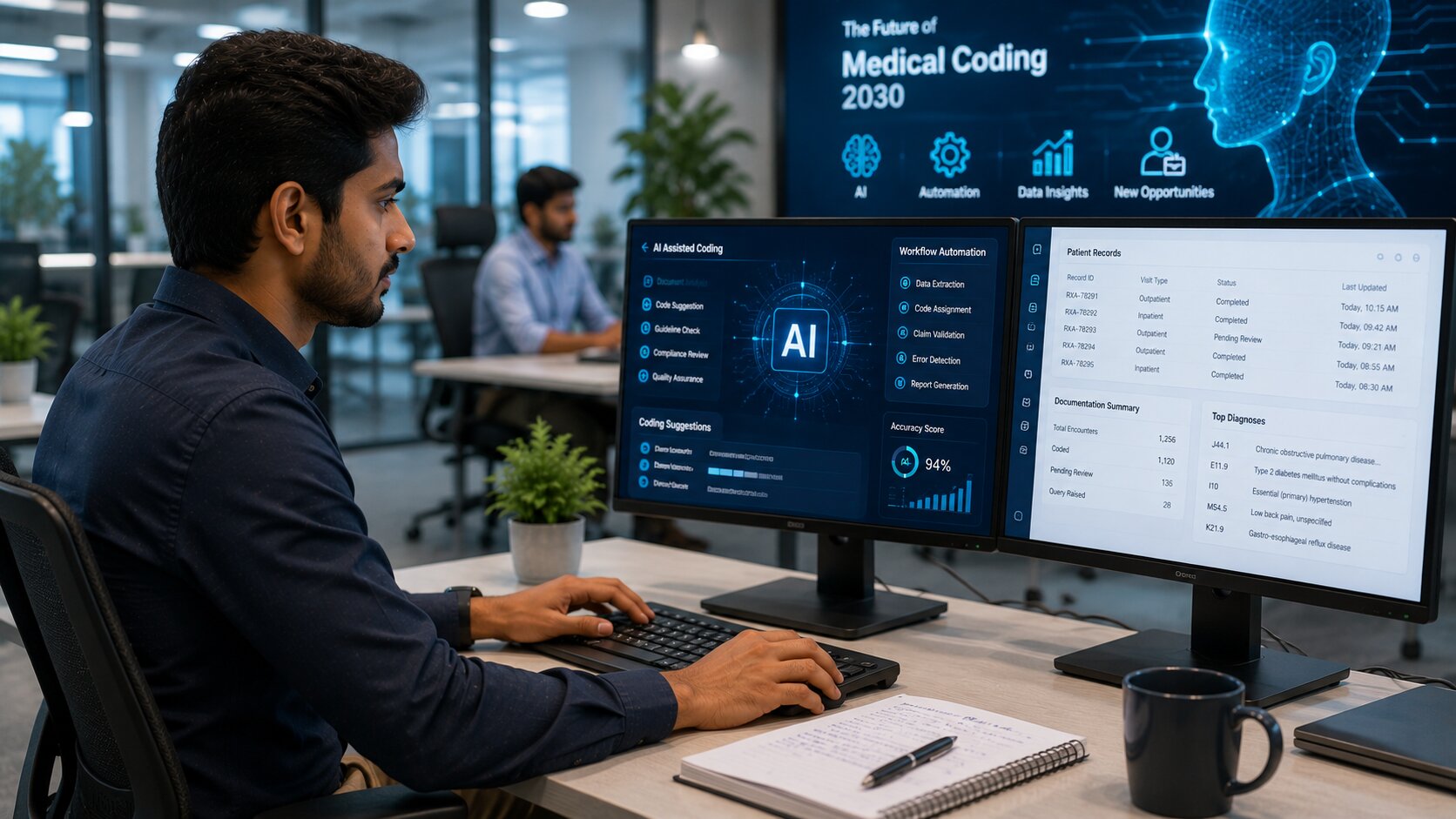
This transformation is creating new opportunities for professionals who understand both medical coding and modern healthcare technology.
How AI May Change Medical Coding
Artificial intelligence can assist healthcare organizations with processing large amounts of clinical information. AI-powered systems may help identify diagnoses, procedures, medical terminology, and other information from electronic documentation. However, technology does not eliminate the need for human judgment. Medical coders still need to understand documentation, coding guidelines, payer requirements, and the context of clinical information.
Automation in Medical Coding
Automation can reduce repetitive tasks in the coding workflow. Depending on the healthcare organization and technology being used, automated systems may assist with tasks such as data extraction, code suggestions, claim checks, documentation review, and workflow management. This means that future medical coders may spend less time on repetitive activities and more time reviewing complex cases and resolving coding issues.
Will AI Replace Medical Coders?
One of the most common questions among aspiring medical coders is whether artificial intelligence will replace human coders. AI can automate or assist with certain coding tasks, but medical coding involves more than selecting codes from documentation. Human professionals are still important for reviewing complex documentation, identifying inconsistencies, interpreting guidelines, handling unusual cases, and making appropriate decisions when automated suggestions require review.
The role of the medical coder may therefore evolve rather than simply disappear.
The Medical Coder of the Future
Future medical coding professionals may need a combination of traditional coding knowledge and technology skills. A successful coder in 2030 may be expected to understand coding guidelines while also being comfortable working with electronic systems, automated coding tools, data-quality platforms, and AI-assisted workflows.
Important Skills for Medical Coders in 2030
Professionals who want to remain competitive should develop a broad range of skills.
- Strong medical terminology knowledge
- Anatomy and physiology knowledge
- ICD-10-CM coding knowledge
- CPT coding knowledge
- HCPCS Level II knowledge
- Knowledge of coding guidelines
- Analytical and problem-solving skills
- Documentation review skills
- Computer and digital technology skills
- Understanding of AI-assisted coding workflows
Importance of Medical Terminology
Even as technology improves, medical terminology will remain an essential skill for coding professionals. Coders need to understand clinical terms in order to evaluate whether automated suggestions accurately represent the provider's documentation. Strong terminology knowledge can therefore help professionals identify errors and review AI-generated coding recommendations more effectively.
Documentation Review Will Remain Important
Accurate coding depends on accurate and complete documentation. Future coding professionals may increasingly focus on reviewing documentation quality, identifying missing information, and determining whether automated code suggestions are supported by the medical record.
AI-Assisted Coding and Human Review
AI-assisted coding systems can provide suggestions based on information contained in clinical documentation. A medical coder may then review those suggestions, verify the supporting documentation, check coding guidelines, and make corrections when necessary. This creates a workflow where technology assists with processing information while qualified professionals provide oversight and validation.
Emerging Career Opportunities
The development of healthcare technology may create opportunities beyond traditional medical coding roles.
Professionals with coding knowledge and technology skills may explore roles involving:
- Coding quality analysis
- Clinical documentation review
- Coding auditing
- Healthcare data quality
- Revenue cycle management
- AI-assisted coding quality review
- Coding compliance
- Healthcare analytics
- Coding education and training
Medical Coding Quality Analysts
Quality-focused roles may become increasingly important as healthcare organizations use automated systems. Quality analysts can review coding accuracy, identify recurring errors, monitor performance, and help organizations improve their coding processes.
Medical Coding Auditors
Auditing is another area where human expertise remains valuable. Coding auditors review medical records and coding decisions to identify errors, compliance concerns, and opportunities for improvement. As automated coding becomes more common, auditing may also involve reviewing the accuracy of technology-generated coding recommendations.
Continuous Learning Will Become More Important
Medical coding is a field that requires continuous learning. Coding guidelines, healthcare regulations, technology platforms, payer requirements, and clinical documentation practices can change over time. Future professionals should therefore develop a habit of regularly updating their knowledge and skills.
Technology Skills for Future Coders
Medical coders do not necessarily need to become software developers. However, basic technology confidence can become increasingly valuable. Professionals should be comfortable navigating electronic health records, coding platforms, documentation systems, digital references, productivity tools, and AI-assisted applications.
Human Skills Will Still Matter
Technology skills are only one part of future medical coding careers. Communication, attention to detail, critical thinking, problem-solving, adaptability, and professional judgment will remain valuable. These skills can help professionals work effectively with both technology and healthcare teams.
How Students Can Prepare for 2030
Students who are beginning their medical coding careers can start preparing for future changes today.
- Build a strong foundation in medical terminology.
- Study anatomy and physiology.
- Learn ICD-10-CM, CPT, and HCPCS coding concepts.
- Practice reading clinical documentation.
- Develop computer skills.
- Learn how AI and automation are used in healthcare workflows.
- Practice coding scenarios and case studies.
- Continue learning after completing formal training.
Is Medical Coding Still a Good Career Choice?
Medical coding continues to be an important part of the healthcare revenue cycle and health information management process. While technology may change how coding work is performed, professionals with strong coding knowledge, analytical skills, and the ability to adapt to technology can continue to find opportunities in the healthcare industry. The key is to prepare for a changing role rather than assuming that the future will look exactly like today's coding environment.
The Future Medical Coding Career Path
A medical coding career can provide a foundation for developing expertise in several healthcare information and revenue-cycle areas. With experience and additional training, a professional may move into areas such as coding quality, auditing, compliance, education, documentation review, or healthcare data analysis. Developing both coding expertise and technology awareness can help professionals remain flexible as healthcare organizations adopt new systems.
Final Takeaway
The future of medical coding in 2030 is likely to involve greater use of artificial intelligence, automation, electronic documentation, and technology-assisted workflows. These developments do not necessarily mean that human medical coders will become unnecessary. Instead, the role of the coder may increasingly focus on reviewing information, validating automated suggestions, resolving complex cases, maintaining coding accuracy, and supporting compliance. Students and professionals who combine strong medical coding fundamentals with technology awareness, analytical thinking, and continuous learning can be better prepared for the evolving healthcare industry. The medical coder of the future may not simply compete with technology — they may use technology as a tool to become more efficient, accurate, and valuable within the healthcare system.
